
History & Honours
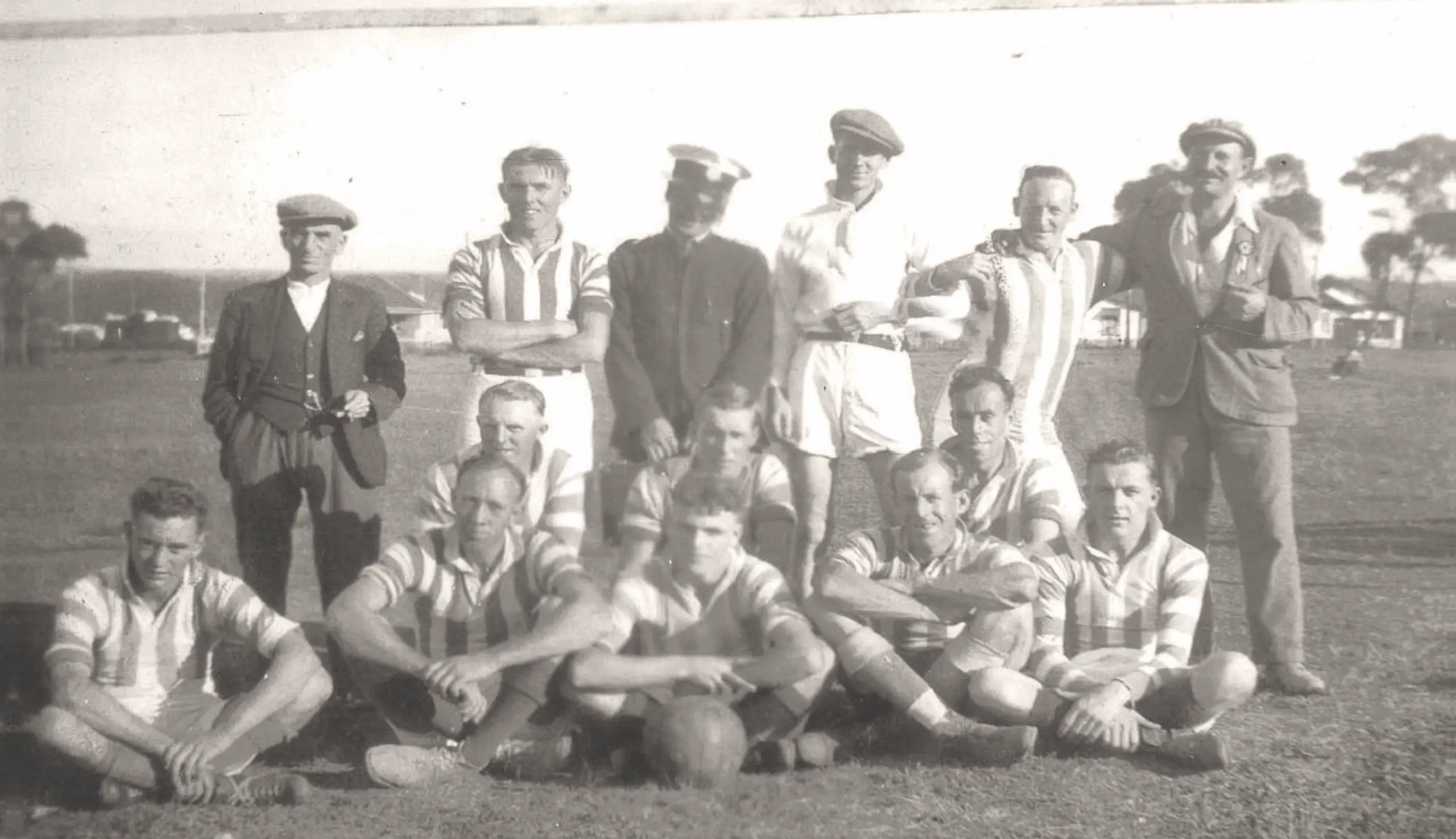
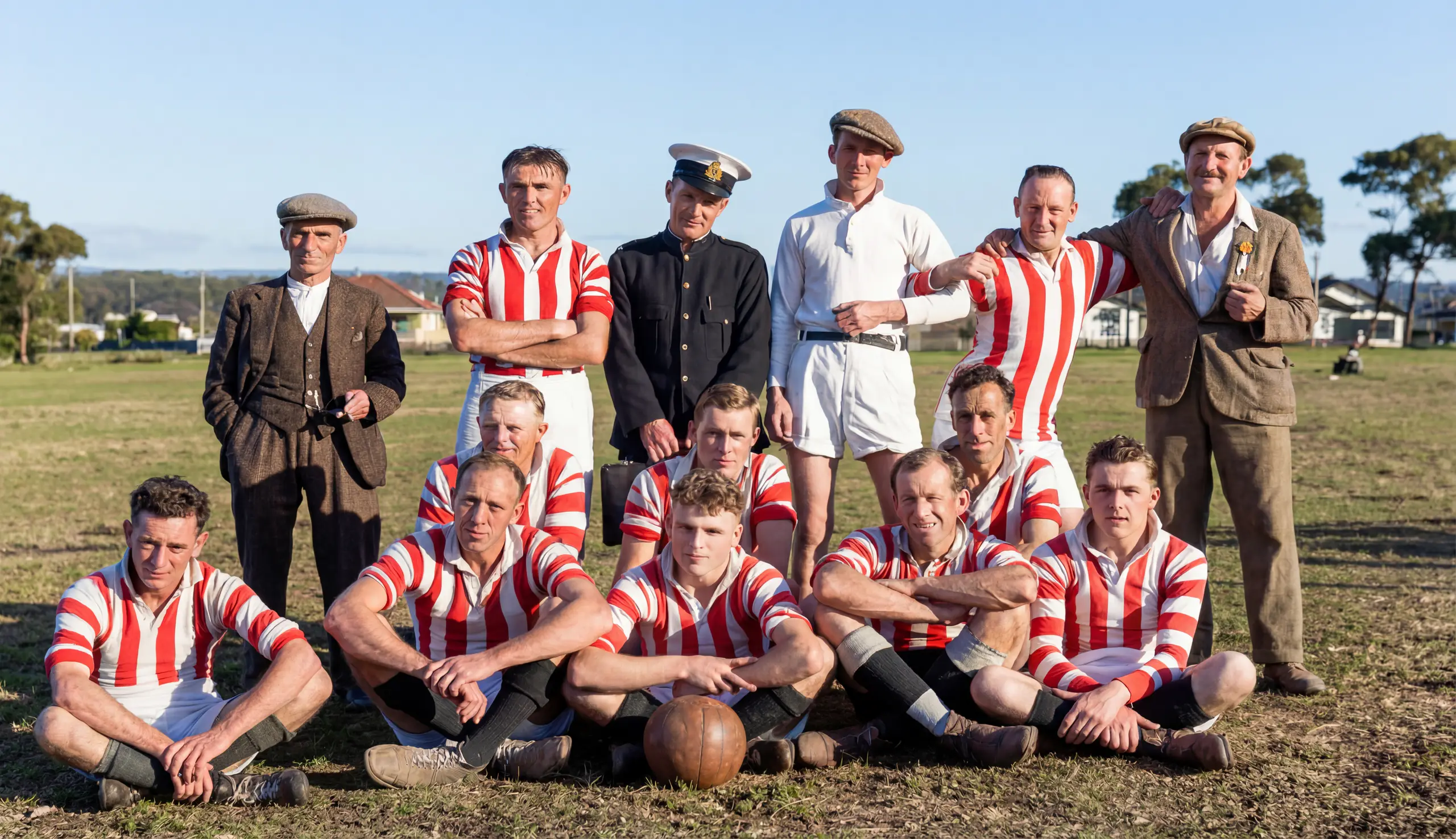
Sutherland United’s First Grade, 1932. Digitally restored and colourised, 2026.
Since1930
Pommy Gully, now Kareela, was home to many British families. One Sunday afternoon in early 1930, after a morning training run and a cool-off in the local swimming hole, a group of its men met at J. Nicholls’ house, made their team official and elected him president. They called it Sutherland United and toasted it with cups of tea from his wife. Ninety-six years on, it plays on the national stage.
1932
The first team
Taken with a box brownie on the Sutherland ground, just before kick-off. The club’s president and secretary, who had founded it two years before, stand among the players.
Back row
- J. NichollsPresident
- Bill Vance
- The ZambuckFirst-aid man, name unknown
- William GayleardGoalkeeper
- Jock Moir
- William BanksPlayer-coach
Middle row
- George Anderson
- William L. TannerSecretary
- Walter Edwards
Front row
- George Mackrell
- P. Avery
- Rowly Nicholls
- George Edwards
- Bob Shearer
You might be able to see the vast crowd in the background; never a dog was there, but we enjoyed the game just the same.
1930–46
Pommy Gully
Two shillings a game, army boots with the heels chopped off, and within four years the first Shire team to win the St George District Premiership.
Red and white
Sutherland United Soccer Football Club adopts red and white vertical stripes. Its first ground is cleared land just off President Avenue, between Belmont and Glencoe Streets.
Two shillings a game
The playing fee is two shillings. Boots are hard to come by, so most players wear old army boots with the heels chopped off and leather bars tacked on.
The first premiership
Sutherland United wins the St George District Premiership, beating Rockdale 4–0: the first time a Shire team has won it.
The Casuals
With more players than one club can hold, a second is formed: Casuals Soccer Football Club, in black and gold quarters. By 1936 the Casuals carry the line on, playing at Millers Paddock in Miranda until the end of the war.
Casuals players in their quartered shirts.
1947–58
Finding a home
After the war the Casuals rise through the St George district and win the Metropolitan League, but a top-flight club needs an enclosed ground of its own.
Champions, without a ground
Playing at Tonkin Oval on the reclaimed land of Gunnamatta Bay, the club wins the 1948 Metropolitan League, then has to decline promotion for want of an enclosed ground.
The first game at Seymour Shaw
The juniors play the first match on Seymour Shaw Park’s graded but still rough surface. The lease follows in 1950. The park is named for Edward Seymour Shaw, a Sutherland Shire councillor for 26 years.
Edward Seymour Shaw. The Shire’s own juniors
Now Sutherland Shire Casuals, the club petitions for a junior association of the Shire’s own, the Sutherland Shire Junior Soccer Football Association. Mick Elasi becomes the club’s first Australian Schoolboys international.
The under-16s of 1950, the first team to play a competition match on Seymour Shaw Park: 10–1 against Barton Juniors, seven goals to Colin Tredinnick. Division 3 champions
Sutherland Shire Soccer Football Club, as it has been since 1955, wins the NSW State League Division 3 premiership in both First and Reserve Grade, and is promoted to Division 1 for 1958.
1959–71
Seymour Shaw and the climb
The seniors move to Seymour Shaw for good, and the crowds follow: a club that nearly went under in 1966 is promoted to the top flight five years later.
Home at last
Sutherland Shire moves its senior football to Seymour Shaw Park in Miranda.
The first international
Fiji’s national team visits Seymour Shaw. About 4,000 watch an entertaining 5–3 loss.
By the skin of our teeth
Coach Leo Baumgartner leaves for Sydney Croatia on the eve of the season. Bob Miller and Mick Elasi sign six of the club’s under-18s, and Sutherland survives. Off the field it opens a social club in Miranda, nicknamed the Sharks.
The first Socceroo
John Roche becomes the first Sutherland player selected for Australia. An estimated 5,000 pack Seymour Shaw for the title decider against Marconi, a 2–2 draw.
Promoted
Under player-coach Mike Johnson, Sutherland wins the NSW Division 2 championship. Paul Smith’s goal against Manly seals promotion to the top flight.
Sutherland’s First Grade, 1971.
1972–91
The top flight
Sutherland enters the NSW First Division in 1972 and won’t be relegated for 30 years. The first trophies follow, and Seymour Shaw becomes a home for the national teams.
The first major trophies
Sutherland wins the Ampol Cup, then beats Sydney Croatia 2–1 in the grand final replay at Wentworth Park to become NSW First Division champions.
The Matildas’ first home game
Seymour Shaw hosts the Australian women’s team’s first home international, a 2–2 draw with New Zealand. Captain Julie Dolan is a Shire local.
Julie Dolan, the Matildas’ first captain, at Seymour Shaw in 1979. The Ampol Cup again
Sutherland wins the Ampol Cup for a second time, and is a regular in the finals.
Champions once more
Sutherland beats the Melita Eagles 3–1 at St George Stadium to become NSW First Division champions.
The 1986 NSW First Division champions. The Socceroos come to Seymour Shaw
A record 4,500 watch Sutherland host the Socceroos in a pre-tournament friendly.
A newspaper’s report of the match. Sutherland Sharks
The club officially becomes Sutherland Sharks, and finishes its first season under the name on top of the NSW Premier League: premiers.
The 1991 premiership trophy.
1996–2008
The fall and the return
A new grandstand and a Super League title, then the first relegation in three decades, and a sponsor who brings the club back.
Super League premiers
Sutherland wins the NSW Super League premiership as Seymour Shaw gets a new grandstand.
Relegated
Sutherland is relegated from the top flight for the first time since promotion in 1971.
Back in the Premier League
With John Hills and his company Pipe King as major sponsor, Sutherland wins a place in the new 10-team NSW Premier League.
The first synthetic pitch in NSW
John Hills’ donation makes Seymour Shaw the first synthetic pitch in NSW and the first in Australia with FIFA certification. Frank Farina and Graham Arnold open it under new lights.
Premiers, and Sydney FC beaten
Sutherland finishes as NSW Premier League premiers and Brendan Gan wins the league’s Gold Medal. In a friendly before a record 5,000, Matthew Hall’s winner beats A-League champions Sydney FC 2–1.
Brendan Gan, the league’s player of the year in 2008.
2009–19
The treble and the pathway
The best season in the club’s history, and a generation of juniors who take Sutherland to the world.
The treble
Sutherland wins the Waratah Cup (then the TigerTurf Cup), the Minor Premiership and the NSW Premier League grand final, 4–1 against Marconi at Penrith, with the pre-season Leader Cup as well.
At Manchester United
The under-15s beat 158 teams to become Oceania’s side at the Manchester United Premier Cup in England, and beat Wigan Athletic 7–0 on the way.
The under-15s in England, 2010. The Waratah Cup again
Sutherland wins the 2012 Waratah Cup, and the Youth Club Championship follows in 2013.
Fifty years of Paul Smith
Paul Smith receives Football NSW’s Charles Valentine Medal for more than 50 years with the club as a player, coach and administrator.
Paul Smith with the Charles Valentine Medal. The Matildas return
Forty years after their first home game, the Matildas return to Seymour Shaw before the Women’s World Cup. The under-20s complete a hat-trick of championships, 2017 to 2019.
The Matildas at Seymour Shaw, 2019.
2025–
The new Seymour Shaw
A new clubhouse and a new pitch, and the first national competition in the club’s 96 years.
A new clubhouse
The club opens a new clubhouse with a gym, a commercial kitchen and offices, a new playing surface and Smithy’s, a bar and lounge named for Paul Smith.
The national stage
The Sharks play the Australian Championship, the club’s first national competition in 96 years.
Before the first game, v South Melbourne, 2026.
Made at Sutherland
The people
Socceroos, coaches and a president: a few of the people who came through Seymour Shaw.

1967–69
John Roche
A Como West junior who became Sutherland’s first Socceroo.

Since 1961
Paul Smith
Joined as an under-8, scored the goal that won promotion in 1971, and was president from 2006 to 2021.

1977–84
John Watkiss
A Socceroo defender who arrived as player-coach, was NSW Player of the Year in his first season and led the Sharks to their first trophies.

1970s
Graham Arnold
A Gwawley Bay junior who played for the Sharks from under-8s to under-15s, earned 56 Socceroos caps and coached Australia to the 2022 World Cup’s round of 16.

1990
John Kosmina
One of Australia’s greatest strikers, with 60 caps, who brought star power to Sutherland for a season.

2007, 2009–14
Robbie Stanton
The former NSL defender who coached the 2009 treble and the 2012 Waratah Cup, then went on to the A-League.

2010s
Cameron Devlin
Played from under-12s to First Grade at Sutherland, then went to the Olympics, the Socceroos and the 2022 World Cup.

2007–14
Tom Glover
A Shire goalkeeper who left Sutherland for Tottenham Hotspur’s academy, then kept for the Olyroos and won an A-League title.
Honours
The honours board
Every senior title Sutherland has won, and its NSW players of the year.
NSW Second Division Premiers
Ampol Cup
NSW First Division Champions
NSW Premier League Premiers
NSW Super League Premiers
Waratah Cup
NSW Championship Series
NSW Premier League Club Champions
Youth Club Champions
NSW players of the year
- John McDonaldRothmans Medal
- John WatkissRothmans Medal
- Grant BardNSW Player of the Year
- Brendan GanGold Medal
- Brad BoardmanNSW Player of the Year
- Panny NikasNSW Player of the Year
94 years apart
From a paddock off President Avenue to Seymour Shaw Stadium: the red and white stripes are sky blue now.

Drawn from the club’s 2026 research for the Founders Club mural and George Swattridge’s account of the early years. Know more, or have a photo? We’d love to hear from you.